First minoxidil patients
Begins treating hair loss with topical minoxidil in his New York practice, years before an approved product existed.
Long before compounded hair-loss formulas were sold online, a Manhattan physician was mixing minoxidil with tretinoin and asking a simple question: what if absorption, not the drug, was the limit?
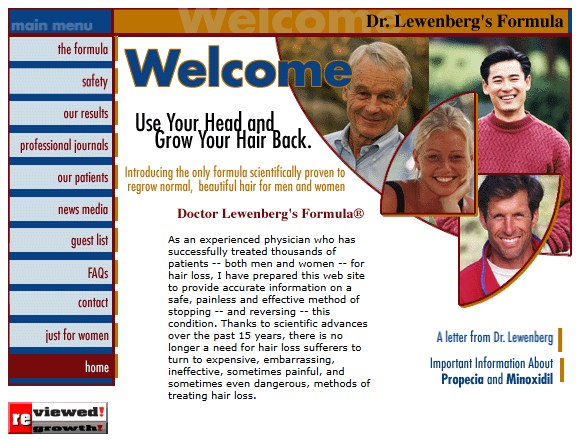
Adam Lewenberg, MD, practiced on Manhattan's Upper East Side and built one of the first physician-run hair-loss sites on the web, baldspot.com. He described himself as a pioneer in the medical treatment of hair loss and was a Life Member of the New York Academy of Sciences.
He was among the first doctors to prescribe minoxidil for hair loss in private practice, beginning in the early 1980s, before Upjohn's Rogaine reached pharmacy shelves. Plain minoxidil helped some patients at the crown, but he wanted something that worked across the whole scalp, including the frontal hairline.
Begins treating hair loss with topical minoxidil in his New York practice, years before an approved product existed.
Develops what became Dr. Lewenberg's Formula, pairing minoxidil with tretinoin. The same year, Bazzano and colleagues publish the first controlled data on tretinoin plus minoxidil in the Journal of the American Academy of Dermatology.
Built by Scott Hoffman's Media Connection of New York (mcny.com), baldspot.com becomes one of the earliest doctor-run hair-loss destinations on the web, debated at length on the forums of the day.
Publishes his two-year clinical study in the September/October issue of the journal Advances in Therapy, covering how often, how much, and how the combination should be applied.
Extends his work to patients regrowing hair after chemotherapy and hormone therapy, from offices at 184 East 70th Street and later 575 Lexington Avenue.
I had the honor of helping Dr. Lewenberg build his first website, baldspot.com. My company, Media Connection of New York, one of the first internet development firms, designed and built the site. I also handled his marketing, which included write-ups in magazines like GQ and Esquire.
He was my client, my mentor and my friend. Working beside him, I learned about hair loss from a physician who had been treating it longer than almost anyone. I spoke with many of his patients about what they were going through and what they needed.
Those conversations are where Regrowth.com came from. Much of what I have built since, including Regenepure, traces back to what I learned in his practice. This site is my thank-you.
Scott Blaine Hoffman, founder of Regrowth.com and Regenepure
Lewenberg A. Minoxidil-tretinoin combination for hair regrowth: effects of frequency, dosage, and mode of application. Advances in Therapy, September/October 1996.
Most minoxidil research of the era asked whether the drug worked. Dr. Lewenberg's report asked how to use it. Drawing on his own patients, he argued that the combination produced growth in every region of the scalp, where minoxidil alone mostly worked at the vertex, and that more frequent application of a lower-strength solution could outperform twice-daily dosing.
He favored spraying the formula over the whole head, so it protected existing hair as well as thin spots, and he recommended applying it several times a day.
Figures as reported on the original baldspot.com. They come from his own patients, not a randomized trial.
Critics in the early forums called his results anecdotal and his formula overpriced. Four decades on, the core idea he pushed, that tretinoin makes minoxidil work better, has real support, though the evidence is still mixed.
In 56 patients, tretinoin with 0.5% minoxidil produced terminal hair regrowth in 66% after one year. Tretinoin alone helped about 58%.
PubMed 3771854Applying tretinoin before minoxidil raised minoxidil absorption roughly threefold compared with minoxidil alone.
In cultured human follicles, minoxidil plus tretinoin promoted growth more than minoxidil alone, by prolonging cell survival and preventing cell death.
PubMed 17449938Five days of topical tretinoin converted 43% of predicted minoxidil non-responders into responders by raising follicular sulfotransferase, the enzyme that activates minoxidil.
An Iranian trial found 0.5% minoxidil with tretinoin roughly matched 2% minoxidil. A 2025 review concluded tretinoin is a reasonable add-on, especially for people who don't respond to minoxidil alone.
Karger reviewDr. Lewenberg's insight was about sequence and absorption. Regenepure's fine-mist minoxidil spray was built on the same idea: an even, light coat that reaches the scalp across the whole head. Used after tretinoin, it puts the combination he championed in reach of anyone with a prescription.
Tretinoin is prescription-only in the US. Ask a dermatologist, your primary care doctor or a licensed telehealth service for a low-strength tretinoin (typically 0.01% to 0.025%) for scalp use, filled at any licensed pharmacy.
Part the hair and apply a small amount directly to the thinning areas. Let it dry fully before the next step. Many people start every other night to let the scalp adjust.
Once the tretinoin is dry, spray the Regenepure minoxidil mist over the whole scalp, not only the thin spots, and let it absorb before bed or styling.
Take photos in the same light every month. Regrowth usually takes four to six months to show and continued use to keep.
Talk to your doctor first. Tretinoin increases how much minoxidil your skin absorbs, which can also raise side effects such as dizziness, a racing heart or unwanted facial hair. Scalp redness and flaking are common at the start.
Don't use tretinoin if you are pregnant, trying to conceive or breastfeeding. Use sunscreen or a hat on treated skin, and stop and call your doctor if irritation is severe.

Former patients, colleagues and press with memories of Dr. Lewenberg or baldspot.com are welcome to write. Questions about the tretinoin and Regenepure protocol are welcome too.